
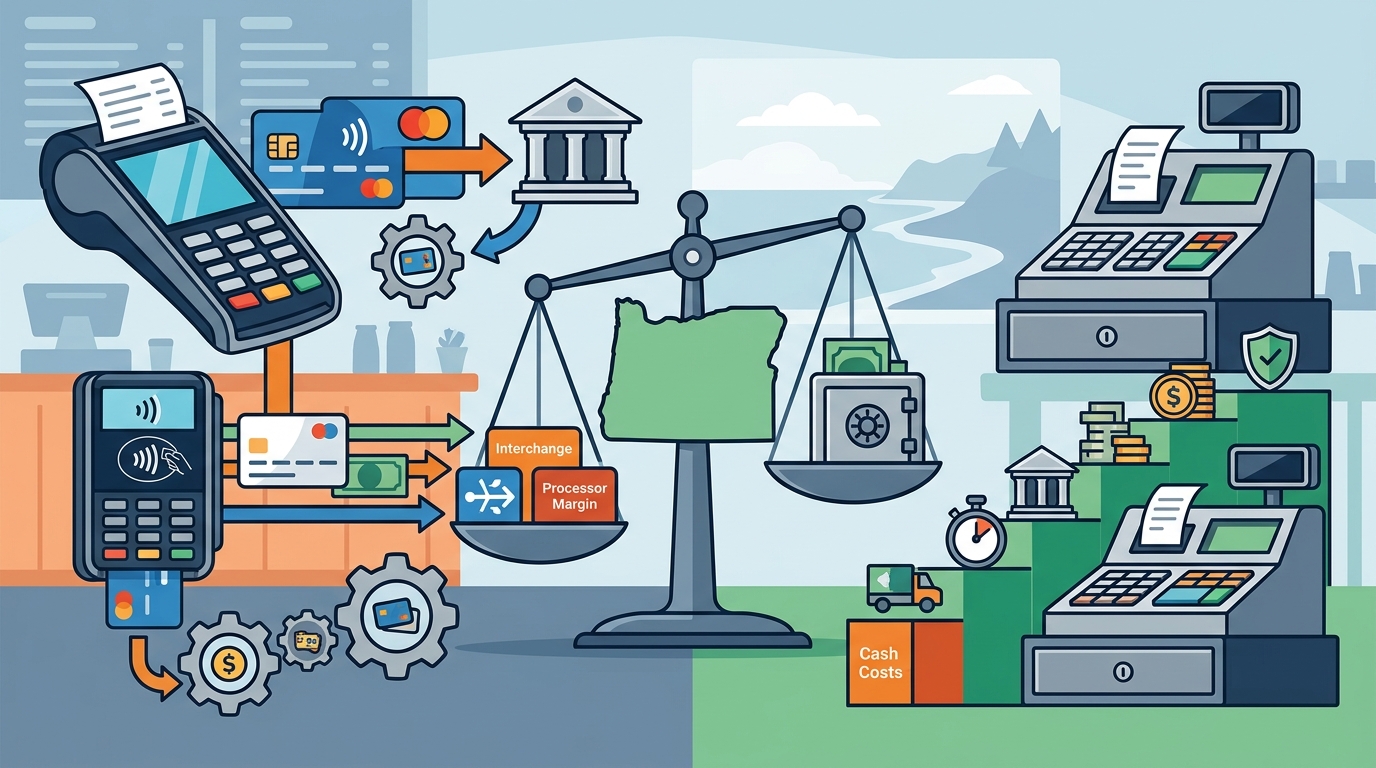
Restaurant payment fees in Oregon vary by card network, processor, and service model. Card transactions typically incur interchange fees plus processor margins, while cash transactions generally have no direct processing fee but carry handling and security costs. This guide breaks down the specific cost structures for Oregon operators, explains state surcharging regulations, and details how to calculate true operating costs for both payment types. We cover the essential financial components every owner must understand before selecting a POS and payment setup.
Card Processing Fees
Card processing fees are the primary variable cost for most restaurant operators. These fees are not a single flat rate but a combination of interchange fees, scheme fees, and processor margins. Understanding this structure is critical for accurate margin analysis. For additional details, review the About Bryant Georgen Process.
Interchange and Scheme Fees
Interchange fees are set by the card networks (Visa, Mastercard, Amex) and vary based on the card type, transaction amount, and whether the transaction is in-person or online. In-person transactions generally carry lower interchange rates than online or mail-order transactions. Scheme fees are additional charges imposed by the networks for network usage and fraud prevention. according to Oregon Department of For additional details, review the POS Services Process with.
Processor Margins and Pricing Models
Typical Cost Ranges
For in-person card transactions, total processing costs typically range from 1.5% to 3.5% of the transaction amount, depending on the card type and pricing model. Amex transactions often carry higher interchange fees than Visa or Mastercard. It is essential to review your processor's pricing model and understand how different card types affect your overall cost structure. For additional details, review the Quick Service POS Process.
Cash Transaction Fees
Cash transactions do not incur interchange or processor fees in the traditional sense. However, they carry significant indirect costs that impact overall profitability. These costs are often overlooked in favor of focusing solely on card fees.
Handling and Security Costs
Handling cash requires dedicated staff time for counting, reconciling, and depositing. Security measures, such as armored car services, safe rentals, and insurance premiums, add to the operational expense. The cost of these services varies based on location, volume, and risk profile. In high-crime areas, security costs can be substantial. according to Division of Financial
Opportunity Cost and Labor
Staff time spent managing cash is time not spent on customer service or other revenue-generating activities. This opportunity cost should be factored into the total cost of accepting cash. Additionally, cash handling errors, such as miscounts or theft, can result in direct financial losses. Implementing robust cash management procedures can mitigate these risks but requires investment in training and systems. according to Oregon Department of
Oregon Surcharging Regulations
Oregon has specific regulations governing the ability to surcharge credit card payments. Surcharging is the practice of adding a fee to credit card transactions to offset processing costs. Understanding these regulations is crucial for compliance and customer experience.
Legal Framework
Oregon law permits merchants to surcharge credit card transactions, subject to certain conditions. The surcharge cannot exceed the actual cost of processing the transaction. Merchants must clearly disclose the surcharge to customers before the transaction is completed. Debit card surcharging is generally prohibited under federal law, with limited exceptions.
Implementation Best Practices
When implementing surcharging, it is important to communicate clearly with customers. Display the surcharge prominently on menus, receipts, and at the point of sale. Ensure that your POS system is configured to apply the surcharge correctly and that staff are trained to explain it to customers. Transparency is key to maintaining customer trust and avoiding complaints.
Cash Payment Fees
Direct Costs
Indirect Costs
Indirect costs include staff time for cash handling, reconciliation, and deposit preparation. These costs are often hidden in labor expenses but should be allocated to cash acceptance for accurate cost analysis. Additionally, cash handling errors and theft can result in direct financial losses, which should be factored into the total cost of cash acceptance.
Key Takeaways
- Card processing fees are composed of interchange, scheme, and processor margins, with in-person transactions typically ranging from 1.5% to 3.5%.
- Cash transactions have no direct processing fees but carry significant indirect costs, including handling, security, and labor.
- Oregon permits credit card surcharging, subject to clear disclosure and limits based on actual processing costs. according to Division of Financial
- Debit card surcharging is generally prohibited under federal law.
- Interchange-plus pricing offers the most transparency for understanding true card processing costs.
- Implementing robust cash management procedures can mitigate risks and reduce indirect costs.
- Transparency in surcharging communication is essential for maintaining customer trust.
- Regularly review your payment processing costs and adjust your pricing model as needed.
Frequently Asked Questions
What is the average card processing fee for restaurants in Oregon?
The average card processing fee for in-person restaurant transactions in Oregon typically ranges from 1.5% to 3.5%, depending on the card type and pricing model. Amex transactions often carry higher fees than Visa or Mastercard.
Can I surcharge credit card payments in Oregon?
Yes, Oregon permits merchants to surcharge credit card transactions, subject to clear disclosure and limits based on actual processing costs. Debit card surcharging is generally prohibited under federal law. according to Division of Financial
Are there fees for accepting cash in Oregon?
There are no direct processing fees for accepting cash. However, there are indirect costs, including handling, security, and labor expenses, which should be factored into your overall cost analysis.
What is interchange-plus pricing?
Interchange-plus pricing is a transparent pricing model where you pay the exact interchange and scheme fees plus a fixed processor margin. This model offers the most visibility into your true processing costs.
How can I reduce my card processing fees?
You can reduce your card processing fees by negotiating with your processor, switching to a more transparent pricing model like interchange-plus, and optimizing your payment mix to encourage lower-cost transaction types.
What are the risks of accepting cash?
The risks of accepting cash include handling errors, theft, and the indirect costs of security and labor. Implementing robust cash management procedures can mitigate these risks.
How do I calculate the true cost of cash acceptance?
To calculate the true cost of cash acceptance, include direct costs such as armored car fees and safe rentals, as well as indirect costs such as staff time for handling and reconciliation. Allocate these costs to cash transactions for accurate analysis.
What is the difference between tiered and flat-rate pricing?
Tiered pricing bundles transactions into categories with varying margins, which can obscure true costs. Flat-rate pricing charges a single percentage for all transactions, which may be cost-effective for low-volume businesses but expensive for high-volume operations.
Conclusion
Understanding the full cost structure of restaurant payment solutions in Oregon is essential for protecting your margins. Card processing fees are variable and depend on the pricing model and card mix, while cash transactions carry significant indirect costs. By reviewing your processor's pricing model, implementing transparent surcharging practices, and accurately allocating cash handling costs, you can make informed decisions that support your business's financial health. Contact Process with Bryant for a free POS review and personalized guidance on optimizing your payment setup.