
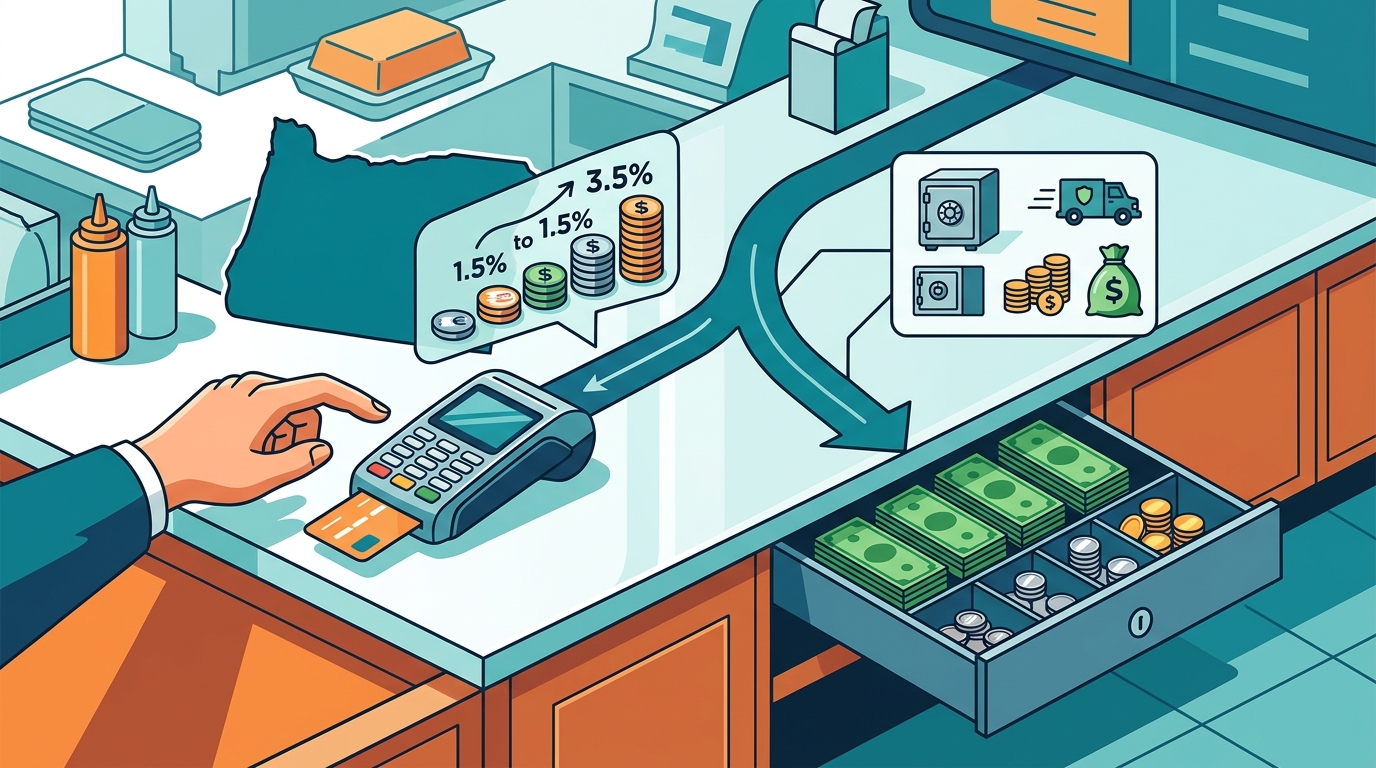
Restaurant card processing fees in Oregon typically range from 1.5% to 3.5% per transaction, while cash transactions incur no direct processing fee but carry operational costs. The exact rate depends on the card type, transaction channel, and merchant category code. This guide breaks down the specific fee structures, Oregon surcharging laws, and cash handling realities for restaurant operators in 2026.
Card Processing Fees
Card processing fees are the primary cost of accepting electronic payments in a restaurant. These fees are not a single flat rate but a composite of several components that vary based on how the guest pays. Understanding these components is essential for accurate margin calculation. For additional details, review the About Bryant Georgen Process.
Interchange Fees
Interchange fees are the largest portion of the processing cost. These are fees paid by the merchant to the card networks (Visa, Mastercard, Amex) and then passed to the issuing bank. The rate depends on the card type and the transaction method. For additional details, review the POS Services Process with.
- Debit Cards: Typically range from 0.5% to 1.5%.
- Credit Cards (Visa/Mastercard): Typically range from 1.8% to 3.2%.
- Amex: Often higher, ranging from 2.7% to 3.5%.
Assessment Fees
Assessment fees are charged by the card networks to cover the cost of operating the network. These are usually a small fraction of a percent, often around 0.10% to 0.15% for Visa and Mastercard. They are generally included in the overall processing rate but are distinct from interchange.
Processor Markup
The processor markup is the profit margin added by the payment processor. This is the most variable component and is where merchants can negotiate. A competitive markup for a restaurant might range from 0.10% to 0.30% per transaction. The total processing rate is the sum of interchange, assessment, and markup.
Cash Transaction Fees
Cash transactions do not incur a percentage-based processing fee like card payments. However, cash is not free to handle. The costs associated with cash are operational and fixed rather than variable per transaction.
Bank Deposit Fees
Security and Labor Costs
Handling cash requires additional security measures, such as safes, armored car services, and staff time for counting and reconciling. These costs are fixed and do not scale with the number of cash transactions. For a busy restaurant, the labor cost of managing cash can be significant.
Shrinkage and Error Costs
Oregon Surcharging Regulations
Oregon has specific laws governing the ability of merchants to surcharge credit card payments. Surcharging is the practice of adding a fee to credit card transactions to offset processing costs. It is not the same as a service fee, which can be applied to all transactions.
Legal Limits
In Oregon, merchants can surcharge credit card transactions up to the actual cost of processing the transaction. This is typically capped at 3% of the transaction amount. The surcharge must be clearly disclosed to the customer before the transaction is completed.
Disclosure Requirements
Merchants must provide clear and conspicuous notice of the surcharge. This can be done through signage at the point of sale, on the receipt, or in the menu. The notice must state the percentage or amount of the surcharge and that it applies only to credit card transactions.
Debit Card Exemptions
Debit card transactions are generally exempt from surcharging in Oregon. Merchants cannot add a surcharge to debit card payments, even if the processing cost is higher. This exemption is designed to protect consumers who use debit cards for everyday purchases.
Key Takeaways
- Card processing fees in Oregon typically range from 1.5% to 3.5% per transaction.
- Interchange fees are the largest component of processing costs and vary by card type.
- Cash transactions incur no processing fee but have operational costs like bank deposits and security.
- Oregon allows surcharging of credit card transactions up to 3%.
- Debit card transactions are exempt from surcharging in Oregon.
- Clear disclosure of surcharges is required by Oregon law.
- Processor markup is the most negotiable component of processing fees.
- Choosing the right POS system can help optimize payment costs and improve cash handling.
Frequently Asked Questions
What is the average credit card processing fee in Oregon?
The average credit card processing fee in Oregon is around 2.5% to 3.0% for swipe transactions. This can vary based on the processor and the specific card type.
Can I surcharge debit cards in Oregon?
No, debit card transactions are exempt from surcharging in Oregon. You can only surcharge credit card transactions.
How much can I surcharge in Oregon?
You can surcharge up to 3% of the transaction amount for credit card payments. This must be clearly disclosed to the customer.
Are there fees for accepting cash?
There are no processing fees for accepting cash, but there are operational costs like bank deposit fees and security measures.
What is the difference between a surcharge and a service fee?
A surcharge is a fee added only to credit card transactions to offset processing costs. A service fee is a fee that can be applied to all transactions, including cash and debit.
How can I reduce my card processing fees?
You can reduce your card processing fees by negotiating with your processor, using a competitive POS system, and encouraging customers to use lower-cost payment methods like debit or cash.
Do I need to disclose the surcharge on the receipt?
Yes, you must clearly disclose the surcharge on the receipt. This is required by Oregon law.
What is the best POS system for restaurants in Oregon?
The best POS system for restaurants in Oregon depends on your specific needs. Process with Bryant can help you choose the right system for your operation.
Conclusion
Understanding the cash and card processing fees for restaurant payment solutions in Oregon is essential for protecting your margins. Card processing fees vary based on the card type and transaction channel, while cash transactions carry operational costs rather than processing fees. Oregon has specific regulations governing surcharging, which can help offset some of the card processing costs. By choosing the right POS system and payment setup, you can optimize your payment costs and improve your overall profitability. Process with Bryant offers a free POS review to help you sort through the options and find the right fit for your business.