
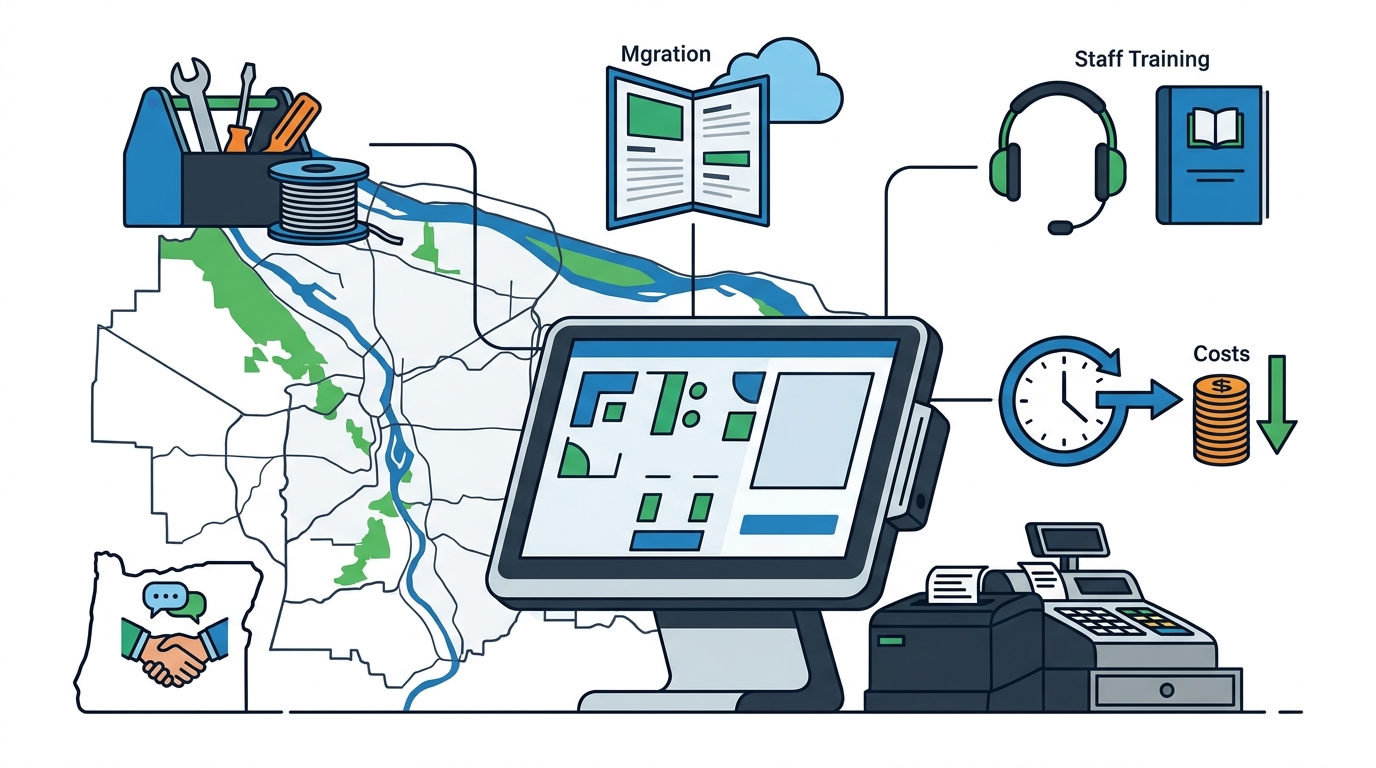
Replacing a restaurant POS system in Portland requires a local partner who can handle on-site installation, menu migration, and staff training. Process with Bryant provides this direct, accountable service for operators across Oregon and Washington. This guide covers how to choose a provider, verify their credentials, understand the installation timeline, and manage the costs involved in a seamless transition.
How to Choose a POS Partner
Choosing a POS provider is less about the software interface and more about the reliability of the human support behind it. A good partner understands the physical layout of your counter and the specific workflow of your kitchen. They should be able to explain how hardware placement affects order speed and staff ergonomics. Process with Bryant focuses on this operational fit, ensuring the system is built around your actual service style rather than a generic template.
Local Accountability vs. Remote Support
Hardware Compatibility
Ensure the provider offers a cohesive hardware ecosystem. Mismatched devices often lead to connectivity issues. Look for a partner who curates hardware specifically for high-volume environments, such as durable terminals and reliable payment readers that integrate seamlessly with the software platform.
Questions to Ask Before Committing
Before signing a contract, you need to understand the scope of the service. Ask the provider who will be performing the physical installation. Is it a third-party contractor or a dedicated employee? Clarify the training process. Will they train your managers, or just provide a manual? Restaurant POS support should be a defined part of the onboarding package, not an afterthought.
Support Availability
Ask about the response time for technical issues. If a terminal fails at 7 PM on a Friday, how quickly can a technician arrive? A local partner in Portland can often provide same-day or next-day service, whereas national vendors may require you to ship a device back for repair.
Menu Migration
Ask how they handle the transfer of your existing menu. A professional installation includes building your menu, modifiers, and tax categories into the new system. This ensures that your staff is not manually re-entering data on opening day.
Verifying Credentials and Claims
It is essential to verify the background of the person or company handling your installation. Check for professional certifications in payment processing and POS hardware. In the Pacific Northwest, many providers are veterans of the hospitality industry. Bryant Georgen, the founder of Process with Bryant, brings a background in public service and the payments industry, which informs a disciplined approach to system reliability.
Checking References
Request references from other restaurant owners in the Portland area. Ask them specifically about the installation day. Did the system work on the first try? Was the team trained effectively? First-hand accounts from local peers are the most reliable indicator of a provider's competence.
The Installation Process and Timeline
A standard POS replacement in Portland typically takes between one to two weeks from contract signing to go-live. The process begins with a site survey to assess power, network, and counter space. Next, the hardware is ordered and configured. The final step is on-site installation and staff training. Restaurant POS station setup involves placing terminals, printers, and customer-facing displays in optimal locations.
Step-by-Step Workflow
- Consultation: Reviewing current workflows and identifying friction points.
- Hardware Selection: Choosing terminals, handhelds, and printers.
- Configuration: Building the menu and setting up payment processing.
- Installation: Physical setup of devices and network testing.
- Training: Hands-on sessions for managers and staff.
Understanding POS Replacement Costs
Hidden Costs to Watch
Be aware of ongoing fees for support, updates, and payment processing. Some providers charge extra for on-site visits, while others include them in the service plan. A transparent quote should break down these costs clearly. Avoid providers who offer a low initial price but charge high fees for basic support or hardware replacements.
Common Mistakes to Avoid
One of the most common mistakes is choosing a system that is too complex for the staff. If the interface is cluttered, order errors will increase. Another mistake is neglecting the kitchen display system. The front of house and back of house must communicate seamlessly. Quick-service POS systems are often streamlined to prevent these errors by simplifying the order entry process.
Ignoring Staff Feedback
Involve your staff in the selection process. They are the ones who will use the system every day. If they find it difficult to use, they will resist the change. A good provider will facilitate this feedback loop during the training phase.
Local Partners vs. National Vendors
POS for Specific Restaurant Types
Different restaurant types have different POS needs. A food truck requires a mobile, durable system that can operate without a fixed internet connection. A full-service restaurant needs table management and split-check capabilities. Food truck POS solutions focus on speed and mobility, while Restaurant & Bar POS systems focus on floor plans and guest experience.
Quick-Service vs. Full-Service
Quick-service restaurants prioritize speed and simplicity. The POS should allow for rapid order entry and payment. Full-service restaurants prioritize flexibility and guest interaction. The POS should support tableside ordering and payment, as well as detailed reporting on guest preferences. according to Top 50 POS
Rules and Consumer Protections
When replacing a POS system, you are entering into a service agreement. Read the terms carefully. Understand the cancellation policy and the data ownership rights. Ensure that you own your customer data and sales history. Privacy policies should clearly state how your data is handled and protected. Look for providers who offer clear, fair terms without long-term lock-in contracts.
Portland and Oregon Specifics
Portland has a unique dining scene with a high concentration of independent restaurants. This creates a competitive environment where operational efficiency is key. Local providers understand the specific regulations and tax requirements in Oregon. They can help you navigate local business licenses and health department requirements. Process with Bryant serves the entire Oregon and Washington region, providing a deep understanding of the local hospitality landscape.
When to Act on a POS Change
The best time to replace a POS system is during a slow period, such as a weekday afternoon or a less busy season. Avoid changing systems during peak holiday periods or major local events. This minimizes the risk of downtime and allows your staff to adjust to the new system without the pressure of a full house. Plan the installation at least two weeks in advance to allow for any unexpected delays.
Long-Term Operational Results
A well-chosen POS system leads to measurable improvements in operational efficiency. Restaurants often see a reduction in order errors and an increase in average ticket size. The ability to track inventory and labor costs in real-time helps protect margins. Over time, the data collected by the POS system provides insights into guest behavior and menu performance, enabling data-driven decision-making. Restaurant POS statistics show that integrated systems significantly improve revenue per guest and customer retention.
Key Takeaways
- Choose a local partner who offers on-site installation and direct support.
- Verify the provider's credentials and ask for local references.
- Understand the full cost, including hardware, software, and support fees.
- Involve your staff in the selection and training process.
- Plan the installation during a slow period to minimize disruption.
- Ensure the POS system integrates with your kitchen and payment processing.
- Review the service agreement for data ownership and cancellation terms.
- Monitor the system's performance over time to identify areas for improvement.
Frequently Asked Questions
How long does it take to install a new POS system in Portland?
Installation typically takes one to two weeks, including site survey, hardware configuration, and staff training. The physical setup on the day of installation usually takes a few hours.
Can I keep my old hardware with a new POS system?
It depends on compatibility. Some providers allow you to use existing hardware if it meets their specifications. However, new hardware is often recommended to ensure optimal performance and support.
Who handles the menu migration?
A professional provider will handle the menu migration, including items, modifiers, and tax categories. This ensures that your menu is accurately transferred to the new system.
What if the system goes down during a busy shift?
Is there a long-term contract required?
How much does it cost to replace a POS system?
Costs vary based on the number of terminals and features. A basic setup might cost a few thousand dollars, while a full-service system with multiple locations can be significantly more. Request a detailed quote from your provider.